GAME CLEAR No. 275 -- Like a Dragon: Pirate Yakuza in Hawaii
video games game clear yakuza like a dragon ryu ga gotoku studio sega playstation ps5Like a Dragon: Pirate Yakuza in Hawaii (2025, Multiplatform)
Developer: Ryu Ga Gotoku Studio
Publisher: SEGA
Clear Version: PS5
Clear Platform: PS5
Clear Date: 1/28/26
| Why should I care? |
|---|
| The Like a Dragon franchise’s most beloved supporting character gets another leading role in the wildest spinoff yet. That’s probably enough for most fans. |
Goro row, row your boat
All right, look. At this point, there are basically nonexistent returns on me writing about, like, what a Yakuza/Like a Dragon game is. I’ve done that before. Even setting that aside, this is simply and obviously not a game that serves as a good jumping-in point for the series. Nevertheless, it’s another entry in my favorite action-crime pulp series, so I had to play it. In the same way it inspired me to revisit Town & Country Surf Designs: Wood & Water Rage, my recent trip to Hawaii brought my mind back to this early-2025 release that I didn’t get around to last year. It’s good in the way most of these games are, and I admire its bold thematic twist, but at this point I do think some RGG fatigue is setting in for me.
It’s not a particularly surprising outcome. Since the series experienced breakout success outside of Japan starting with Yakuza 0, SEGA has pretty clearly been mashing on the gas in an effort to annualize the series. Indeed, since Yakuza 0 released in 2015, at least one new Like a Dragon title, Judgment title, or a remaster or remake of a legacy game has been released every year except 2022. That trend will continue this year with Yakuza Kiwami 3 & Dark Ties set to release in February. Their heavy reuse of environments and assets from previous games makes this steady clip possible. Nothing wrong with that, but even as much as I enjoy these games, their considerable runtimes mean they demand some significant attention just to keep up.
Mercifully, the two Gaiden games (this Pirate game and The Man Who Erased His Name) are much shorter. If you’re just interested in the main story, both can be comfortably beaten in under 20 hours. Both also have the considerable additional side quests, mini games, legacy SEGA titles, and other miscellany to keep you amused for quite a bit longer if you’re so inclined. After nearly two years off, I was ready to spend another couple dozen hours in the world of Like a Dragon.
Pirate Yakuza in Hawaii very much exists in the environment-reuse vein of many of Ryu Ga Gotoku’s games. As its title suggests, the game brings us back to the Aloha State setting of Kiryu’s and Ichiban’s latest adventure in Like a Dragon: Infinite Wealth. Their detailed recreation of a chunk of Honolulu’s famous Waikīkī area returns largely untouched. It’s understandable why they might’ve wanted to squeeze a bit more mileage out of their efforts — it’s difficult to imagine how or why the Japan-based series would return to Hawaii without a serious plot contrivance. Although I suppose a Pirate Yakuza game is just such a wild contrivance.
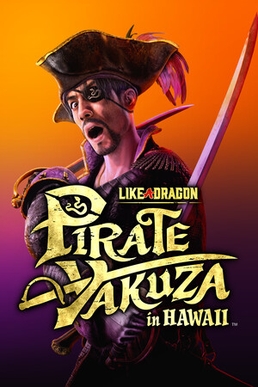
This time it’s fan-favorite supporting character Goro Majima roaming the shores of O’ahu. His wily personality fits the role of pirate captain, and he’s pre-equipped with an eyepatch. How he ends up in Hawaii actually isn’t all that crazy. (Feel free to skip to the next paragraph if you want to avoid spoilers on previous games). It was established in Yakuza: Like a Dragon that the Tojo Clan (the yakuza organization that was the primary focus of the majority of the series) has dissolved. In Infinite Wealth, some out-of-work yakuza take on jobs disposing of nuclear waste in a facility on a remote island relatively near Hawaii. As a former Tojo officer, Majima is sent to the island to check in on and oversee things for a period of time. Needless to say, it takes another leap to get the ol’ Mad Dog of Shimano to become a pirate king.
Turns out Majima doesn’t remember why he was sent to the central Pacific when he washes up on the shore of Rich Island, another made-up tiny island some distance from Hawaii. Yep, he suffers from one of the most annoying tropes in all of Japanese media: retrograde amnesia. A 10-year-old resident of the island named Noah comes to his aid. Long story short, Majima feels indebted to him, resolves to make the boy’s dream come true of seeing the world beyond his tiny island home, and commandeers the ship of a group of pirates that have been causing problems for the denizens of Rich Island to take him on a hunt for long-lost treasure.
I was extremely skeptical of this very stupid setup (including the hand-waving of the language barrier, which is at least directly and humorously lampshaded), but I knew I could forgive it if this strange and unexpected maritime turn for the long-running series was at least fun. In most ways, it is. For all the ways Like a Dragon can be formulaic and by-the-numbers, I have a lot of respect for the big swings its creators have taken — perhaps none bigger than their shift to turn-based combat in the seventh entry of a real-time beat ’em up series. They stuck that landing with incredible aplomb, creating what is one of my absolute favorite turn-based battle systems. If they managed that, why couldn’t they make a fun high-seas adventure?
They mostly did, but I wouldn’t say it’s nearly as successful or deep as their pivot to turn-based battles. That’s not entirely surprising given the unlikelihood of them ever making another game oriented around naval combat.
What’s praiseworthy, again, is that they spun it all up at all. A significant portion of the game is spent sailing Majima’s ship, the Goromaru, around the Pacific to various fictional island locales. Sailing around is easy enough, and sea battles against roving pirate fleets are a pleasant mixup from the random fistfights I’m used to from hours roaming the streets of Kamurocho, Sotenbori, and beyond.
Fighting opposing ships has just enough going on to be interesting. At your disposal primarily are port and starboard cannons, bow-facing machine guns. When trouble strikes, you can drop smoke bombs to obscure your ship and take your hand off the wheel to perform urgent repairs. While hidden, Majima can also squeeze off a couple shots from his trusty rocket launcher. To avoid enemy fire, you also have turbo boosts and drifting (lol) for maximum maneuverability. In random encounters, you can usually dispatch opponents by just firing away and not worrying much about your own hull (as it should be). In the more intense story and side-quest battles, you’ll have to be as nimble as you can while also managing to keep your opponent in firing range as often as possible. That balance is fun to manage.
To have your ship in optimal fighting shape, you’ll have to recruit folks to man your ship and spend time upgrading your weapons and hull. This is the most significant role Honolulu plays, as the largest open world area of the game. It features the shop where you can craft new weapons for your ship using materials you find (yay…). Just as importantly, it’s also where you will find the majority of your mateys. Some of them require minor favors. Maybe they’re looking for a common item or need you to fend off some hooligans in a quick fight. Others agree to join Captain Majima after lengthier substories. The quality of the recruit is usually proportional to the level of effort required to get them aboard, but in the early going you really just need warm bodies.
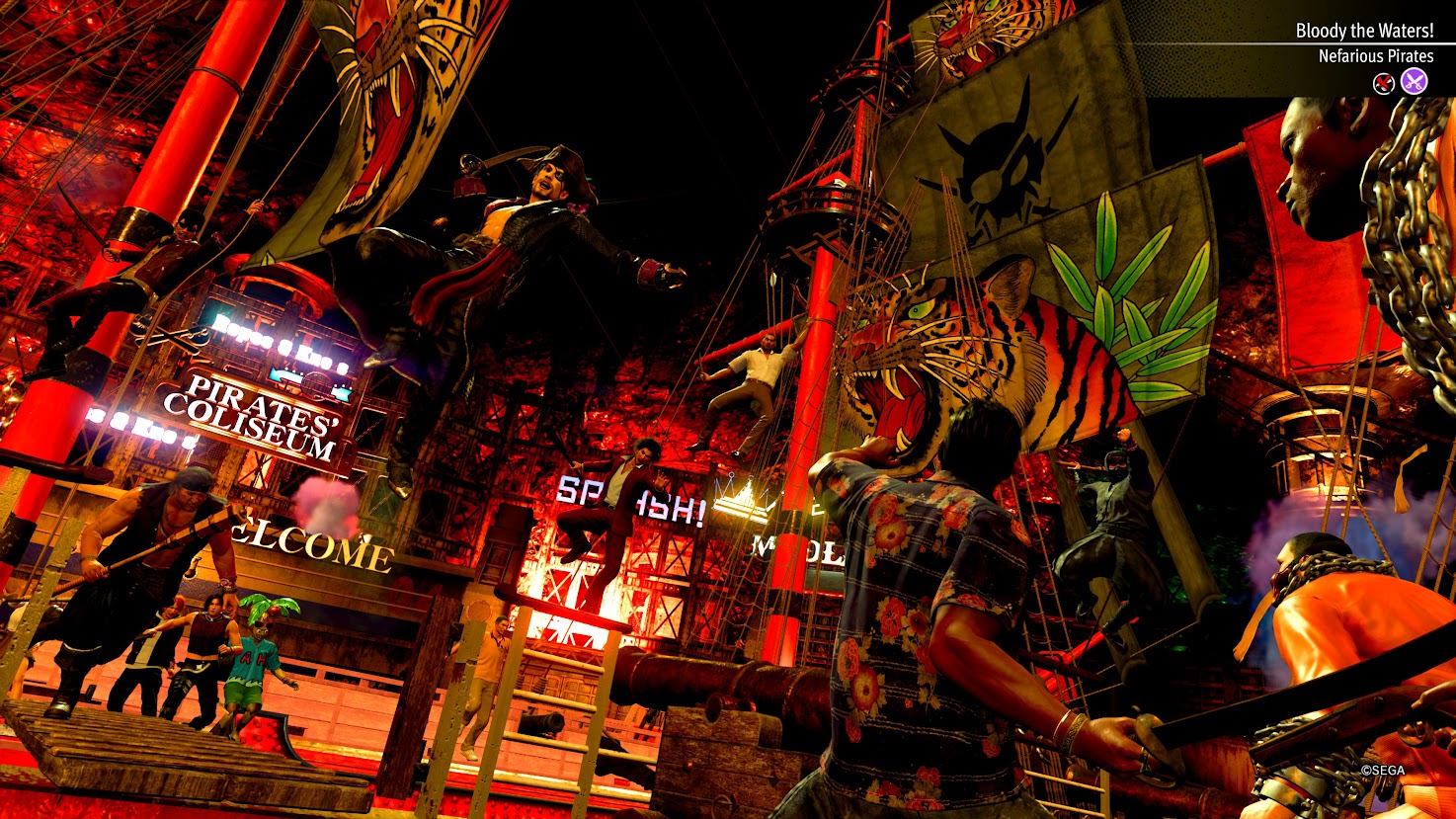
The other locale you’ll be passing through often is Madlantis, a hidden underground den of skullduggery and the epicenter of pirate activity on the seas of Hawaii. Your quest for the treasure you seek as part of the main story takes you through the buccaneer base, where the higher-ups hold some of the secrets thereunto appertaining. By winning pirate coliseum battles, you earn their respect (and simultaneously earn the ire of others).
These battles mix the old with the new. After depleting the health bar of your opponent’s ship, you then board it with your crew. An all out brawl ensues on the deck of the enemy ship with the old-fashioned beat ’em up gameplay of the earlier Like a Dragon entries. Majima can fight in his traditional “Mad Dog” style or in a new “Sea Dog” style. The former involves his classic dagger and fist-fighting movies while the latter employs dual cutlasses, an old-timey pistol, and a chain hook. Broadly speaking, I found the Mad Dog style great for one-on-one fights against bosses and the Sea Dog style great for crowd control, befitting the 40+ person fights the deck battles entail. Both were fun to master and feature the classic, crunchy, tight combat the series is known for. I appreciate RGG for continuing to give us beat ’em up fans some games to enjoy.
The mix of maritime and hand-to-hand battles also drive the game’s most compelling side mode, the Devil Flags quest. The Devil Flags are the most notorious band of pirates in the seas surrounding Hawaii and get on Majima’s bad side when they murder a man in cold blood who was in possession of the area’s most valuable treasure. Majima enlists his grieving daughter to his crew and promises to help her exact revenge on the fiends.
To take them down, you must sail around to the small islands surrounding the main story areas and ransack the various Devil Flags encampments. In addition to taking their valuable treasures (worth actual money you can use for ship and personal upgrades), roughing up enough of them will reveal the locations of the four captains of the organization. Naturally, each is stronger than the last, so you’ll have to keep upgrading your ship and crew to keep pace. This little side story is pretty fun to see through. It can be repetitive, but it’s the part of the game that feels the most “piratey.” It also rewards you with cursed instruments, which are sort of “ultimate weapons” that you can use to summon various animal gods to wreak havoc on your enemies. If you see this series of quests through to the end, you’ll certainly be prepared for even the toughest stretches of the endgame.
But when you’re not running around trying to take down the Devil Flags or complete the series’s signature off-the-wall side quests to improve your crew, you’ll eventually have to take on the main story. Mentally free from his prior obligations thanks to his amnesia, Majima is single-mindedly focused on finding the lost treasure of Esperanza. Before long, a familiar face from the Tojo clan arrives to remind him why he was originally sent to Hawaii, but somewhat unsurprisingly, it turns out Majima’s and the Tojo’s interests are not totally unaligned, nor are they the only parties interested in tracking down the Esperanza loot.
Well, eventually all that happens. There’s a bit of a slog in the early going as the game is introducing system after system. This obviously makes sense for all the pirate stuff, but being reintroduced to a million things in Honolulu that I already knew about from Infinite Wealth certainly made me grit my teeth a bit.
Anyway once you get through the tutorial gauntlet, the story begins in earnest. After awhile, the conflicting parties converge, and the classic protagonist-against-the-world stakes arise that the series is known for. It’s ultimately a very goofy tale, and you have to suspend a lot of disbelief to go along with it — even more than usual for the series. That it seems to be at least semi-canon is even more ridiculous (although it winks at this absurdity often an unambiguously). I think going into a game with Pirate Yakuza in its title expecting a great, airtight plot and thought-provoking themes and rhetoric is probably a fool’s errand, and I certainly didn’t. Still, I can’t deny that I at least found its ending earnest and heartwarming, which is higher praise than I’d anticipated I’d have for the game’s plot.
Man, I started this blog post not planning to write a lot about this game. Here I am ~1900 words later trying to wrap it up, confused about what happened. I think one of the tricky things about writing about games is that it’s hard to know what concept the reader has of the game you’re discussing in their mind. If you assume to much, you may say things about it that don’t make a lot of sense to a reader. If you assume too little, you spend a lot of time and words describing a game rather than analyzing it. It’s an issue that’s really been on my mind lately about how I might improve my writing on here. A problem I think I sometimes have is that after spending so many sentences simply describing mechanics or a game world (or whatever else) in objective terms, I’ll then not offer much beyond “it’s good” or “it’s annoying.” Not great.
What I’d like to do instead is make sure I’m communicating why and how. Oh, the combat in RGG feels good? How so? Well, it’s got swift, sharp animations, punches and kicks are satisfyingly sticky, and attacks come out as quickly as you’d like them to. Move variety helps it keep from getting boring. Those are nice qualitative descriptors, yeah? Am I always doing that? I don’t think so.
Graphics and sound are always an afterthought for me too, unless they’re particularly impressive or otherwise complementary to the rest of the game. Something to mention in an odd paragraph somewhere, breaking up the flow of the other stuff I’m talking about. Wish I had a better way of working that in.
And anyway, I always say I don’t want these posts to just be straight reviews anyway. Ideally, I’d rather they be more focused pieces that maybe highlight one way the game is exceptional or interesting or made me think or feel something I haven’t thought or felt about another game. Something pithy and something that makes an argument. Not just a description of the various parts of the game and whether or not they form a gestalt that I give a thumbs up or down to. That’s sort of why I added the “Why should I care?” block, to try to get at that sort of thing. I don’t think I’ve really accomplished that quite yet.
I do realize that the very nature of writing about every single game I finish does not lend itself to all of them being incredible essays. For one thing, some games are simply unexceptional. For another, I’m simply not going to devote the time necessary to write really great stuff every time I sit down for one of these. Nevertheless, I think I can up my average.
Nearly 300 posts in, I’d still like to level these pieces up. If 60-year-old Majima can become a pirate to beat them all, I reckon I can punch up my GAME CLEAR posts. See you at the next one.