GAME CLEAR No. 276 -- Earthion
video games game clear ancient ykggg limited run games ps4 playstation bitwave games genesis mega driveEarthion (2025, Genesis/Mega Drive)
Emulated versions were released on most modern platforms
Developer: Ancient Corporation, Bitwave Games
Publisher: Limited Run Games
Clear Version: PS4
Clear Platform: PS5
Clear Date: 1/31/26
| Why should I care? |
|---|
| Ancient’s brand new Mega Drive shoot ’em up is one of the most gorgeous titles ever released for the platform and a clever and beginner-friendly example of the genre. |
We’re not worthion
Hearing that Yuzo Koshiro’s company Ancient is making a brand new shoot ’em up for the Mega Drive is the type of news that makes you say “hell yeah, brother.” At least that was certainly my response when I heard about the project a couple years ago. The man and team responsible for Streets of Rage and Beyond Oasis could surely do no wrong returning to the platform. In the worst case, I knew it would at least have a killer soundtrack. Indeed it does, but it has so much more as well. Koshiro’s return to the 16-bit SEGA console has brought us a rock-solid shooting experience with thoughtful, modern design and some of the best visuals to ever grace the platform.
Ancient deserves props in the first place for choosing to develop for the aged platform. They could’ve easily made a retro product in the style of the Mega Drive, and Koshiro could’ve even made the whole soundtrack with the original sound chip but otherwise made the thing in Unity or whatever. They’d have been able to make an homage product while being free from the constraints of the actual machine. I doubt they’d have lost many customers. With the way the game is packaged, a layperson could be forgiven for thinking the versions on Steam et al. are running natively on whatever hardware they’re using rather than running in an emulator wrapper. It is the highest integrity option, though, and I hope the planned cartridge release finds its way to many happy homes.
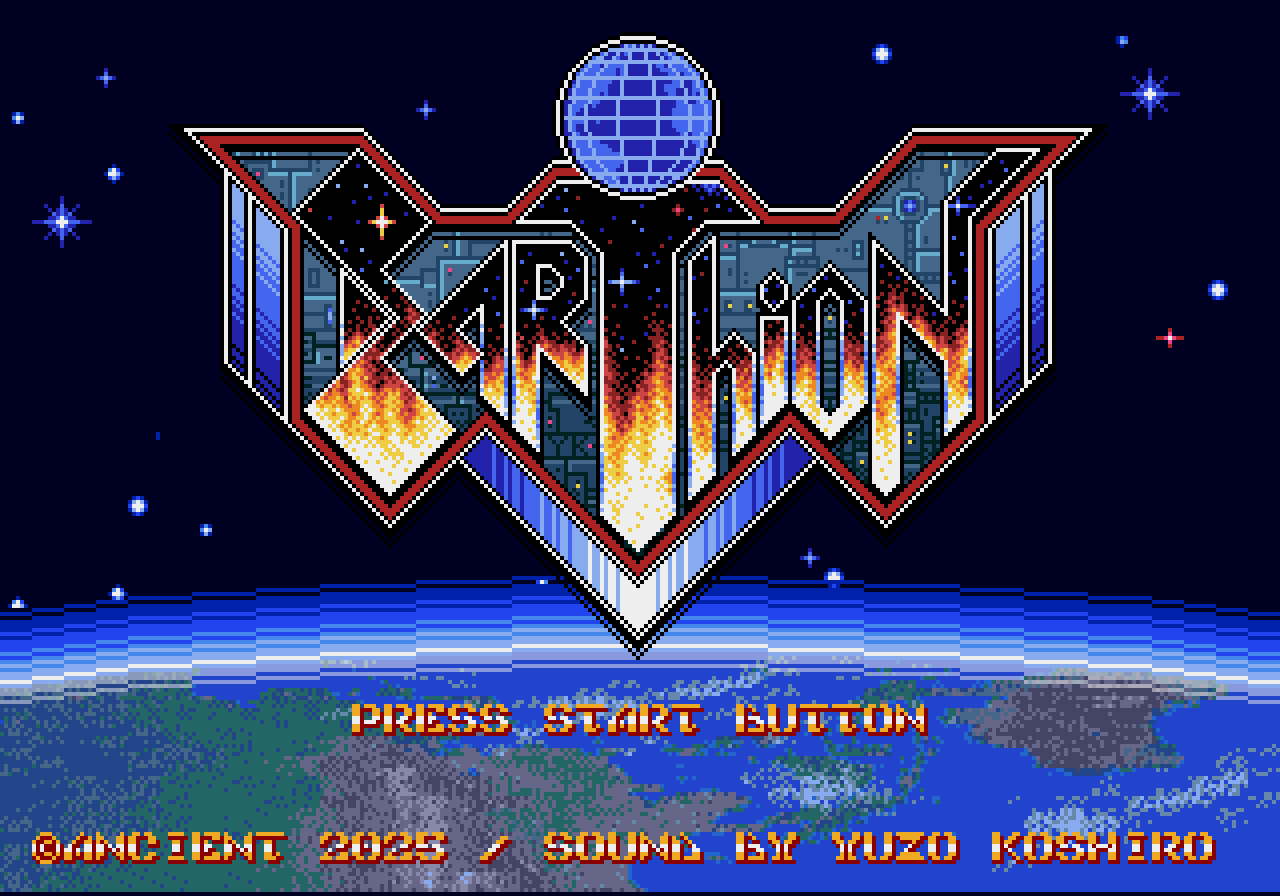
The biggest upside to their decision to target the vintage hardware is that it makes everything they accomplished that much more impressive. I’m sure I’ve not seen a prettier Genesis game, and some of the effects they managed are truly dazzling. It’s also a very modern product for the old Mega Drive. It’s got bonus challenge modes, some useful option adjustments, and a robust password system useful for really playing the game your way.
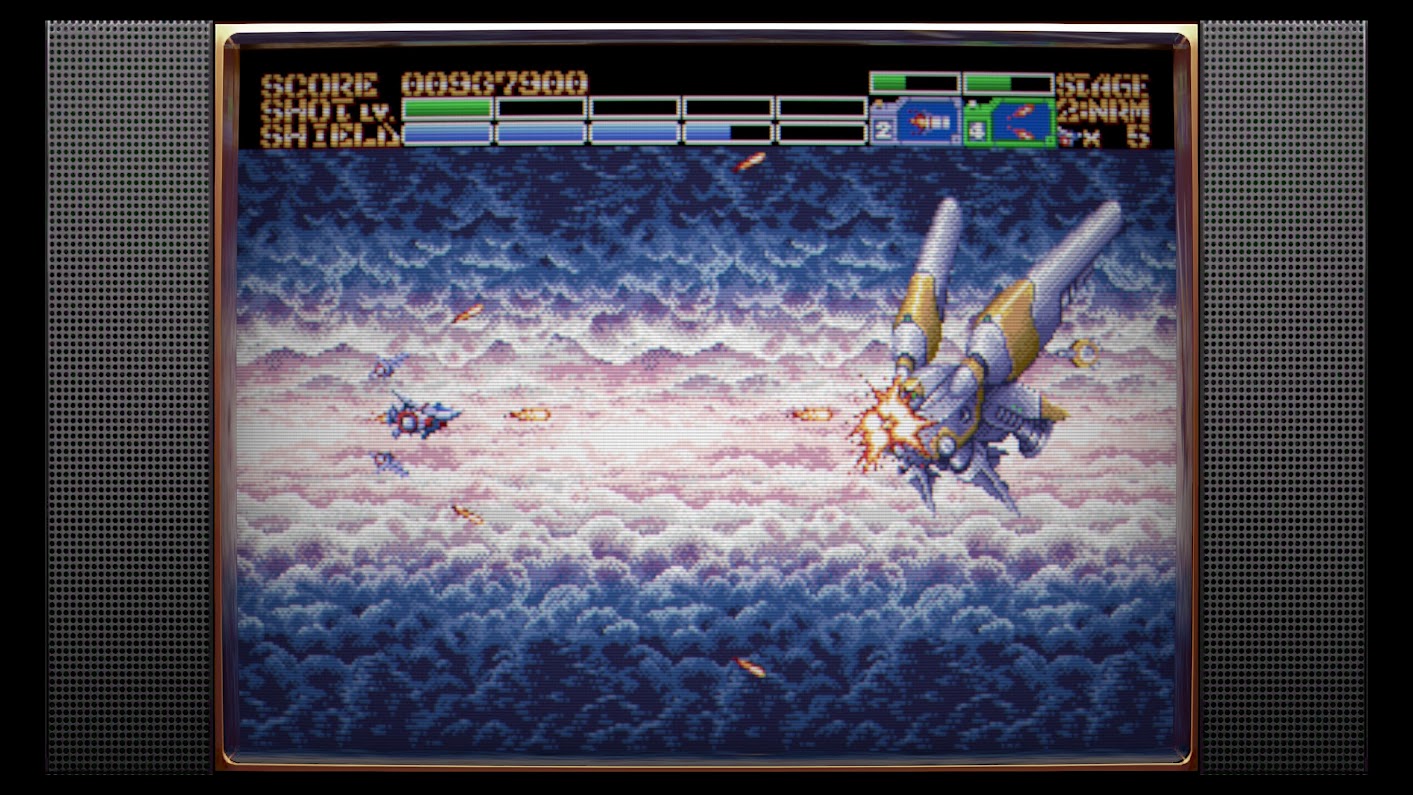
This is a game we’re talking about, though, so flashy visuals and technical achievements aside, gameplay is king. Ancient’s retro blaster delivers there as well. It has lots of the hallmarks of the genre: tons of guys to shoot, screen-filling bosses and challenging mini-bosses, all dropping ample power-ups and sub-weapons to seek out. The sub-weapons are varied and interesting, and the stages are designed to specifically befit and hinder the use of different weapons, so experimentation is encouraged. Visual feedback, explosions, and sound effects all help keep the action comprehensible even as the screen fills with enemies and lush backgrounds and environmental hazards. Occasional voice-acted radio chatter in the signature super-compressed sound of the time assists here and there as well. A lot of this is genre-standard stuff, but it’s all also perfectly easy to fuck up. Ancient managed to nail the basics.
However, while I would describe myself as neither an expert on nor connoisseur of shoot ’em ups, what I most enjoyed were the things Earthion brought to the table that if not unprecedented, are at least uncommon among games contemporary to the original release of the Mega Drive.
Namely, I was impressed by its shield, upgrade, and password systems. Right from the jump, the way your ship’s shields work makes this game significantly easier than its peers. Instead of dying in one shot, your shield meter begins to decrease after taking hits from bullets or colliding with enemies or walls. After a period without getting hit by anything, they will slowly recharge back to maximum strength. This by no means makes the game a walk in the park, but it at least makes it feel more manageable. If you have a particularly rough section, you can make up for it by being a little more careful and evasive for the next 30 seconds or so. Since there are natural ebbs and flows in on-screen chaos, this is often pretty achievable.
What’s more, your ship gets better every stage (if you can manage it). By collecting and keeping an “adaptation pod” (usually dropped by an enemy shortly before the stage boss), you can select an upgrade for your ship between stages. You can increase your two meters (base weapon power and shield), add another sub-weapon slot, increase the level of your sub-weapons, or simply opt for an extra ship. The slight inconvenience of having to ditch a sub-weapon to grab the adaptation pod is well worth it for these permanent upgrades.
They’re more permanent than they may seem, too. That’s where the password system comes in. When your game ends, whether it be by beating the final boss or reaching a game over, you are presented a password. It allows you to start the game from the beginning with your ship in the state it was in when your game ended. This means that even after a series of games over, you can eventually max out your ship. Needless to say, this makes subsequent runs that much easier! Passwords earned on lower difficulties can also be used for higher difficulties as well, so you can take on the increased challenge with your ship configured exactly how you like it. This helped me immensely when I took on (and finished) the game on Normal difficulty after finishing it first on Easy.
All of these features serve to make the game a great, accessible shoot ’em up option for folks new to and/or apprehensive about the genre. That’s awesome, but it’s equally cool how many customization options it unlocks for challenge runs. You have eight upgrade chunks total. Two are initially shields/weapon power and two are sub-weapon slots. You can distribute the remaining four however you like. If you’re unconfident in your flying skills like me, you may choose to max out shields at the expense of offensive flexibility. On the other hand, maybe you’ll forego upgrades altogether! The choice is yours.
So the gameplay and systems are pretty great top to bottom. I did suffer the occasional surprise death because I hadn’t quite noticed how much damage I was taking. A natural consequence of not exploding instantly on contact with any damaging entity, I suppose. Overall, though, it felt great to pilot my ship.
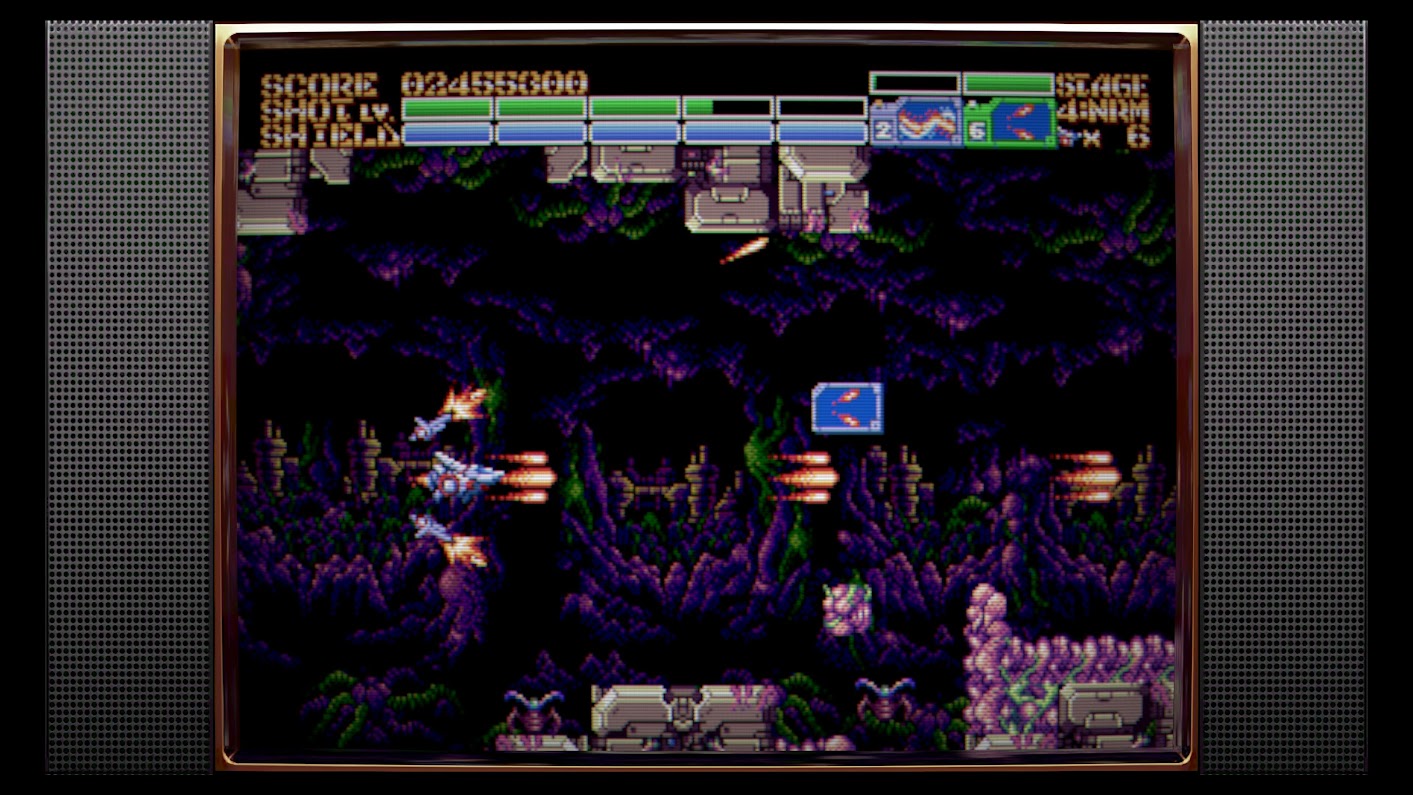
Stage designs are solid and nicely varied, running the gamut from cityscapes to dreadnoughts, to industrial areas overgrown with gross monster mass. Enemy variety is staggering and never boring. Like the structures of the stages themselves, they seem designed with great intentionality with respect to how they interact with the different weapons of the game. Bosses are similar — having the right weapon can nearly trivialize some of them. On the other hand if you have no sub-weapon at all and only the basic blaster, they still feel winnable if you really lock in (at least on the lower difficulties). Often the focus seems to be on on making it difficult to actually hit the boss rather than overwhelming you with bullets. It makes for fun puzzles to solve.
Great gameplay and level design are nice and all, but what we’re all here for is the story, right? Typical of a game of this sort, it’s pretty thin, but it is at least beautifully presented. An opening cutscene explains that Earth, having had its resources mostly depleted, has largely been abandoned in favor of terraforming other planets. A few dedicated research and science types chose to stay behind to continue to investigate a possible solution to rejuvenate Earth. With Earth considerably less protected now, an invading force emerges from the dark side of the moon (that’s from the opening text verbatim) to take over Earth (despite its apparent barrenness?). Their initial assault is devastating, but tech recovered from some of the ships the Earthlings were able to shoot down was researched and repurposed into a new ship, the YK-IIA, which protagonist Azusa Takanashi pilots in Earth’s last-ditch counteroffensive. The forces behind this counteroffensive call themselves “Earthion.” Why not?
It’s enough to get things rolling and at least establish a vague identity for our plucky leading lady and the folks she’s talking to on comms. It’s got a nice closing sequence too, but naturally I wouldn’t dare spoil what I can neither confirm nor deny is a heart-wrenching, emotional finale.
I’m overdue to talk about the soundtrack, though. Yuzo Koshiro is known perhaps above all as an absolute wizard with the Mega Drive sound chip, wringing absolute bangers out of the old tinny device. I was excited to see his work on this game, especially because the nature of an auto-scrolling game is that he could time his musical changes to the action on the screen. I was glad to see he took advantage of this fact, with some particularly tasty transitions echoing in my mind as I write this. Having said that, I was also a bit disappointed. Although the soundtrack is as full of bangers as I expected, they are often rather drowned out by the countless explosions and bullet fire of the game’s action. It’s a shame, because I also purchased a cassette of the soundtrack and it is killer. Still, I only half begrudge it because Koshiro’s SFX work on this game is terrific as well.
Inaudible music notwithstanding, what Koshiro and Ancient accomplished here exceeded my expectations in pretty much every regard. I have a lot of respect for the shoot ’em up genre. I love its persistence in the gaming zeitgeist and how straight-up video gamey shmups are. They are pure, white-knuckle action from beginning to end. Still, I must admit I often simply do not have the mettle to stick with some of the genre’s more demanding examples. With this game, victory always seemed within reach, so I stuck with it and was able to clear the game on Normal difficulty with a continue to spare. For the sickos, there’s always Hotshot difficulty. Maybe with the password system, I can manage that someday too.
This release also marks the first under the YKGGG label, which stands for “Yuzo Koshiro Golden Game Generation”. Koshiro has stated he intends to use the label for future projects (contingent, I’m sure, on the success of Earthion). If his next project contains the same level of love, attention, and care as this one, I shall anxiously await it.