GAME CLEAR No. 277 -- Wario World
video games game clear gamecube switch 2 nso nintendo treasureWario World (2003, GameCube)
Developer: Treasure
Publisher: Nintendo
Clear Version: GameCube via Nintendo Classics app
Clear Platform: Switch 2
Clear Date: 2/2/26
| Why should I care? |
|---|
| This is Wario’s only solo 3D outing, which at least makes it a curiosity. It’s also full of freaks if you’re into that. |
Wario number one?
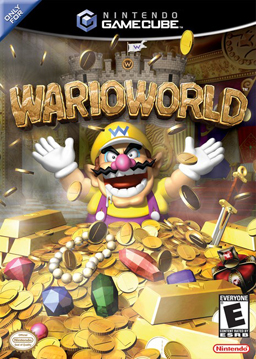
Welcome to Wario World! When it first released in 2003, Wario’s first and only 3D adventure was met with lukewarm reception and sales. Save for some moves in Super Smash Bros., the game has remained largely unacknowledged by Nintendo in the ensuing 23 years, not unlike a number of their other GameCube games (irrespective of quality). Having never been offered among Nintendo’s Virtual Console offerings, GameCube-exclusive titles have sat in an awkward spot for awhile. Some of the heavy hitters have been ported or remastered, but many have been essentially unavailable for two decades or more. With the release of the Switch 2, we finally have a system powerful enough (I guess) to emulate GameCube games to the level of Nintendo’s satisfaction. We can finally play Wario World again. I missed it on its initial release, so I was pleased to see it announced. Having now played it, I see I wasn’t missing much. I don’t regret playing the game, though, and while its gameplay is often frustrating, its not totally forgettable by virtue of its strangeness.
I’m going to digress a bit to talk more about Nintendo’s treatment of its catalogue titles, as I’m often inclined to do after playing these games. Nintendo’s choice of what to prioritize on their legacy platform emulation apps has been pretty puzzling. Stone cold classics will often go neglected for years while shit like Prehistorik Man gets dumped on the app seemingly at random. I don’t mean to pick on that game in particular — truthfully, I have no idea if it’s good or bad. I also don’t think only games deemed good by consensus deserve a spot on the platforms. Nevertheless, Nintendo’s release schedule for their subscription-only emulation products has raised more eyebrows than just mine. Wario World is no exception to this pattern. It’s just the 7th of now 8 titles released for the Switch 2-exclusive GameCube emulator, and myriad more cherished titles come to mind. Even when my beloved F-Zero GX launched simultaneously with the Switch 2, I’ll admit I was surprised it was chosen to usher in the next Nintendo generation given its relatively niche stature in the company’s lineup.
Having said that, maybe there’s a bit more rhyme and reason to this than meets the eye. Looking at the GameCube’s best-selling titles, many have indeed been recently re-released (Metroid Prime), are not Nintendo IP (Sonic Heroes), or both (Resident Evil 4). Additionally, some of the titles that have been released so far command some of the highest resale prices of the GameCube library. Among first-party titles, Chibi-Robo! and Fire Emblem: Path of Radiance are in fact the very most expensive (source). Wario World, F-Zero GX, and even Wind Waker are not priced quite so egregiously, but they still routinely sell for more than their original MSRP. You might think those prices are a product of their lack of more recent availability, and perhaps that’s at play, but re-releases actually don’t tend to have the cooling effect on prices for the original release as might be intuitive. Just look at Earthbound. Finally re-released in North America in 2013, the then-expensive cartridge has more than doubled in value in the aftermarket since then.
All that is to say, while these choices may be head-scratchers at first glance, they’re actually welcome additions. You can prattle on and on about how easy it is to emulate the GameCube on a computer (or probably even phones now?), but the bottom line is there is nothing that gets more folks to play a game than making it legally and easily available on their current hardware of choice. If the Switch 2 sells remotely as well as its predecessor, people that have one will vastly outnumber people who even know what an emulator is.
We were here to talk about Wario, though, right? Should you rush to buy a Switch 2 so you can finally play Wario World? Probably not.
Wario World is a game I remember playing exactly once briefly at a friend’s house. It didn’t leave much of an impression, but it has remained in my mind as an unchecked box of the old GameCube library. Having had a bit of time to kill before the release of Dragon Quest VII Reimagined, I decided to check that box, knowing it was a short game.
What I got was a game that I’d say has the bones of a decent 3D platformer but makes some pretty baffling decisions about its prosody of play.
To back up a bit, the whole deal here is that, as in his Wario Land titles, Wario is a treasure hunter who spends most of his time in his castle admiring his collection. On his latest expedition, he had the misfortune to bring home the cursed Black Jewel. It awakens in the heart of his hoard and transforms his castle into four separate platforming worlds connected by a hub, as was the style at the time. Wario must traverse these monster-filled worlds to recover his treasure. More importantly, he must rescue the Spritelings, the beings capable of sealing the Black Jewel away and restoring the world to its normal state.
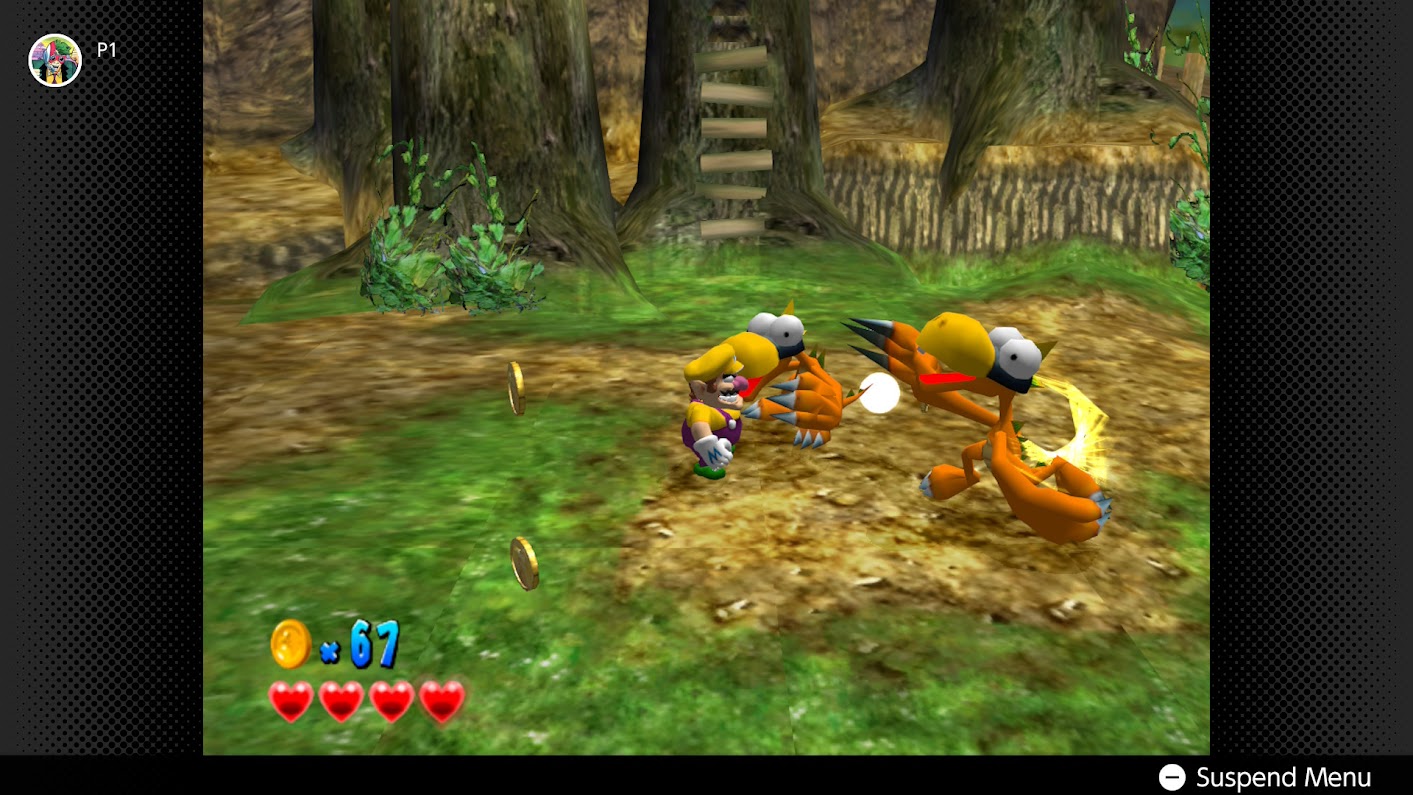
So, you go do what Wario does. The basics feel pretty good. You run around, press A to jump, and B to punch. You can also do a ground pound, and Wario’s signature shoulder charge returns if you hold down B (or press R). These actions are nice and responsive with pleasing sound design. Platforming sections are generally well-designed and suited to the small moveset Wario possesses. You may occasionally have to bust out the spinning long jump activated by jumping after starting a shoulder charge, but for the most part the platforming is straightforward and unfrustrating. As a treasure-hunting game, the challenge is more in making sure you don’t miss any nooks, crannies, etc. This works pretty well.
Where things get bogged down is the combat. Little guys can generally be dispatched with a punch or two, and that’s pretty satisfying. Where I encountered significant friction was with the mid-sized enemies, which must be wrangled for a variety of secondary functions. These guys get knocked into a dizzy state after a few punches, at which point Wario can hoist them over his head. From there, he can toss them into obstacles or buttons (which reveal treasure chests), piledrive them into terrain or gates that are too sturdy to be broken by a basic ground pound, or spin them around and around to activate certain environmental elements. The game asks you do at least one of these actions seemingly constantly, and it really slows things down. If you accidentally defeat all of the enemies that can be picked up or flub your piledrive or spin move, you’re going to have to walk some distance away and return, allowing them to respawn. It’s simply not a very rewarding or exciting loop.
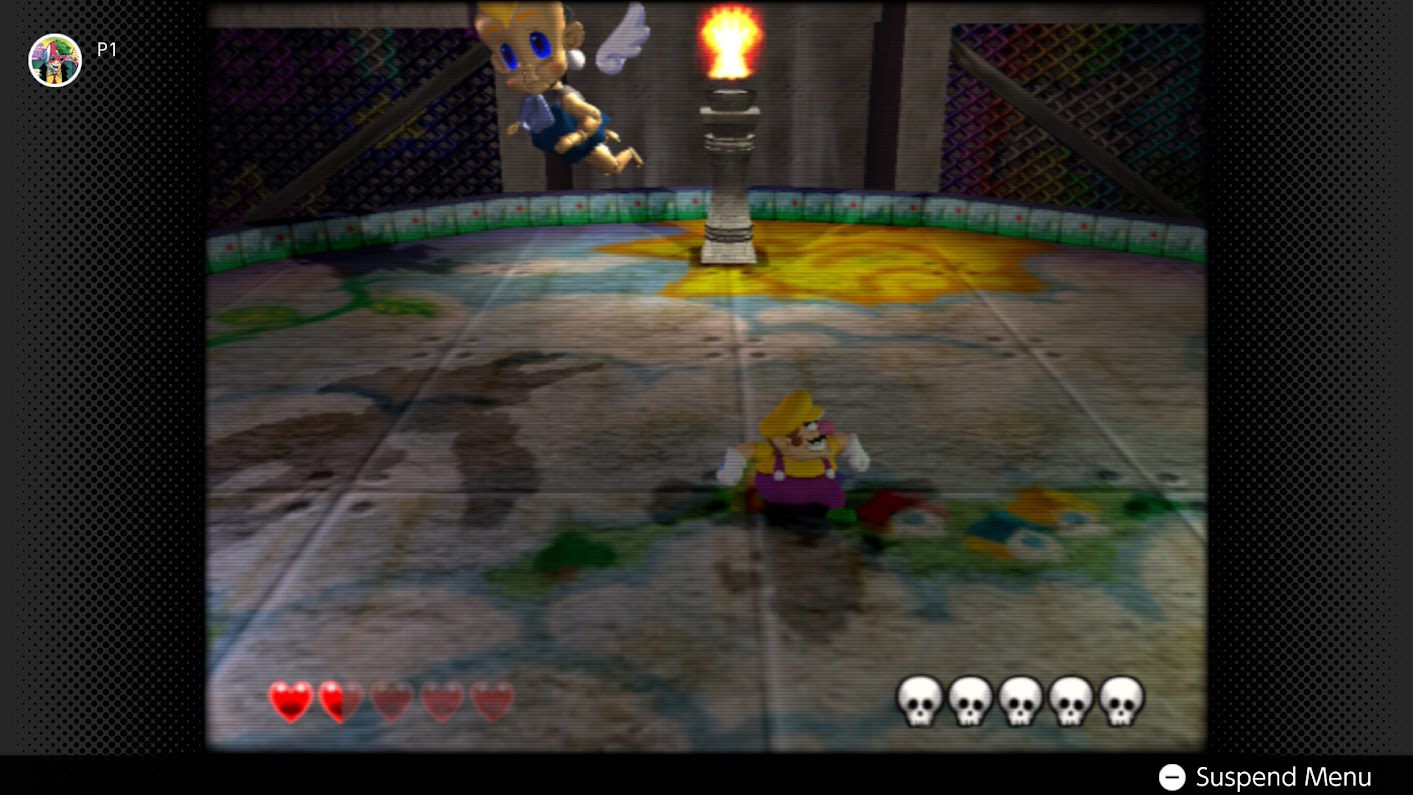
The enemies, for their part, are also a real menagerie of weirdos. That’s not really a problem, but it’s certainly a bit odd coming from the enemy design language of the Wario Land games. I haven’t found anything to confirm this is the case, but the dissonance made me half expect that the game had begun development as a non-Wario game and was retroactively turned into one (like Star Fox Adventures). The characters fit Treasure’s style (especially, say, Dynamite Headdy), but they feel out of place in a Nintendo game. Chief among the bizarre enemies are the bosses, who are truly unpleasant to behold. On the plus side, they tend to offer a nice challenge. Half the puzzle is figuring out how to damage them in the first place, but this always becomes clear after a bit of thought. It’s a nice bit of discovery. The letdown here is that the final boss is among the most boring and underwhelming I have ever fought!
The soundtrack is pretty bizarre as well, but in a way I dig more than some of the other aesthetic choices. There are some cool, funky tunes buried in this relatively unheralded game. It also has probably the most annoying pause music in history. I’ll leave Googling it as an exercise to the reader. Suffice it to say that in that theme (and in his little chirps throughout the rest of the game), Charles Martinet has perhaps never delivered a better performance as Wario.
Back on the platforming side of things we also have a mixed bag. The main 3D worlds of the game have generally appealing designs and varied environments. Some draw from the classic platformer tropes (grassland, desert, etc), some are a bit more exciting, like the carnival stages. As I mentioned before, these tend to be fairly simple to navigate. The trick is usually in being thorough to avoid missing any collectibles. Each stage has six Spritelings to free, eight Wario Statue pieces to find, and eight red crystals to discover. Only the crystals are strictly necessary, as a certain number will be necessary to open the gate to the boss of each stage. As a collectathon platformer enjoyer, I found joy in the hunt and wasn’t satisfied with finding anything less than every trinket. Fortunately, this was seldom especially difficult.
For the most part, I enjoyed the designs and quirks of each of the overworlds. There were times when a frustrating fall or awkward jump led to some irritating backtracking, but those did not dominate the experience. Furthermore, I laud the game for generally doing a pretty good job of managing the fact that its levels are semi-linear yet it is collectible-driven. Points of no return within levels are generally well-communicated so you can make absolutely sure you’ve found everything before you proceed. If you do end up missing something and have to return to the level, there is a balloon that will fly you roughly to the middle of the stage to track down what you missed (as well as one at the end to take you to the beginning).
There’s an entirely separate yet equally essential aspect to the platforming as well. In each stage, there are several sub-stages accessed by trap doors (often requiring you to drag an enemy over to piledrive open). These take two general forms. Some are little puzzle boxes that involve solving a small platforming challenge. Others are much larger platforming stages that are reminiscent of the F.L.U.D.D.-less stages in Super Mario Sunshine. In both cases, they’re pretty fun even if not particularly challenging — at least until the final stage, when they become diabolical. They do seem a bit odd, though. Couldn’t these sorts of things have been worked into the stages themselves instead of abstracted out into vacuum worlds with floating blocks? You must participate, though, as these sub-stages are where the red crystals you need to finish each main stage reside.
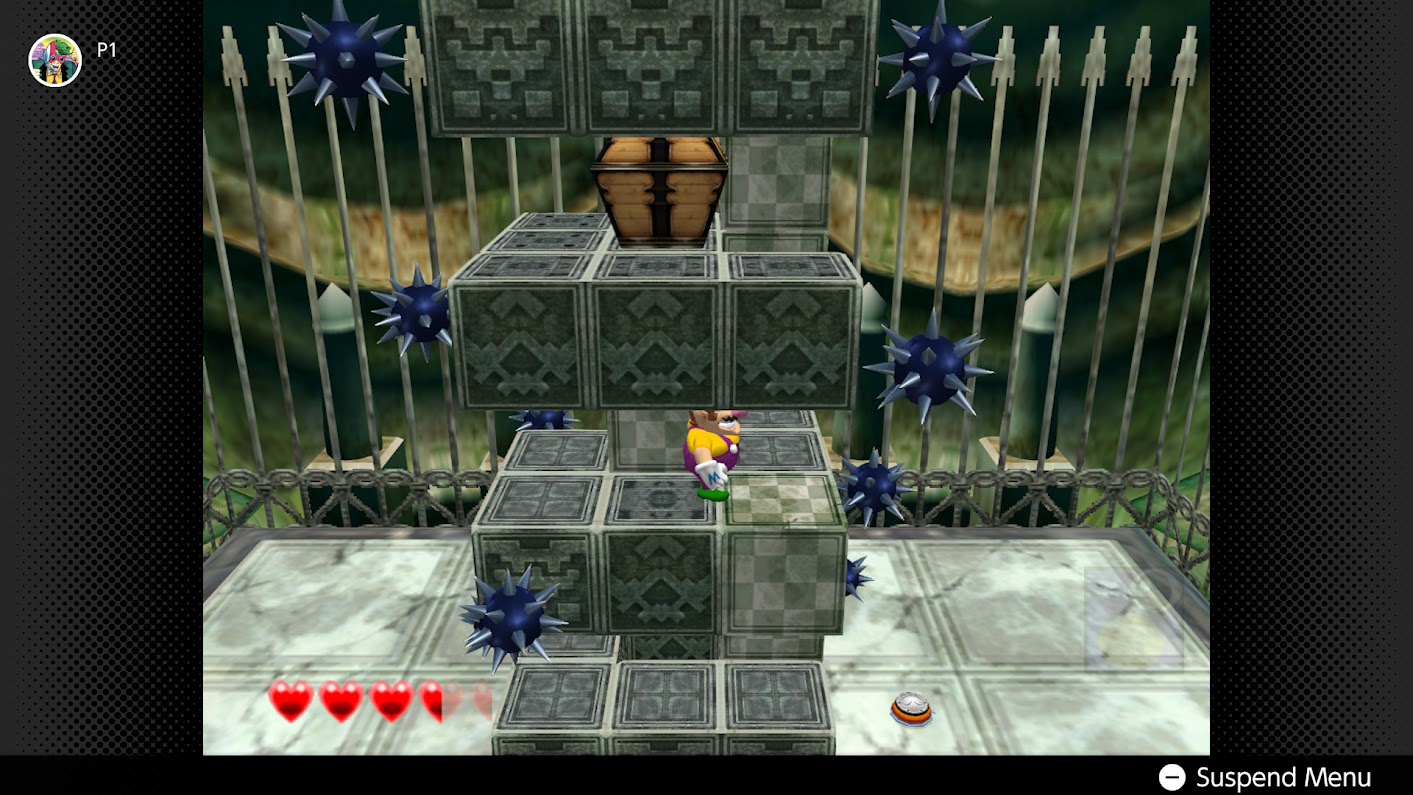
My gripes about the sub-stages’ non-sequitur nature aside, I do at least appreciate that they lack some of the tedium of the more brawling-oriented sections. It’s a much more distilled form of platforming.
That’s “good but bad” vibe is sort of how everything feels in this game. Wario fundamentally feels good, but the game’s insistence on using some of his more overwrought moves drags things down. The worlds are nice to look at, but they don’t feel very “Wario.” There’s some good platforming to be had, but a lot of it is eschewed away into pocket dimensions that don’t cohere with the broader game.
As short as this game is, I don’t feel the need to turn anyone away from it necessarily. It’s nice that it’s here for us to play again, and for as much as it could irritate me, it has an unforgettable weirdness to it as well. Maybe don’t rush this one to the top of your to-do list, but if you get nourishment from even mediocre platformers, it might be worth giving a look the next time you need a brief adventure to burn through.