GAME CLEAR No. 278 -- Red Alarm
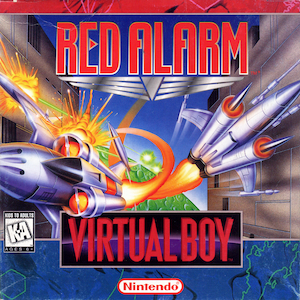
video games game clear nintendo virtual boy nso t&e soft switch 2Red Alarm (1995, Virtual Boy)
Developer: T&E Soft
Publisher: T&E Soft (JP), Nintendo (NA)
Clear Version: Virtual Boy via Nintendo Classics app
Clear Platform: Switch 2 with cardboard Virtual Boy headset
Clear Date: 2/17/26
| Why should I care? |
|---|
| Red Alarm offers one of the platform’s sincerest attempts to deliver on what the Virtual Boy was marketed as. Its shortcomings are largely those of its platform. |
Virtual reality? Virtual bullshit.
Like every game released for the platform, it’s just about impossible to talk about Red Alarm without talking about the Virtual Boy. Owing to their more bespoke hardware configurations, most older consoles have a signature look. They have their own color ranges or 3D rendering quirks, fingerprints of the underlying chips. If you’re seasoned in classic gaming, you can probably tell whether a game is running on NES or Master System from just a screenshot, but I’d wager no platform has a more instantly recognizable look than the Virtual Boy. Its harsh, monochromatic red color palette has, for some reason, never been tried by anyone else. Unashamed of this quirk, at least in name, is Red Alarm, a pretty decent space shooter that in some ways fulfills the promise of the Virtual Boy as well as anything that came out for the doomed console.
Much of the Virtual Boy’s paltry library failed to resemble virtual reality at all. Even its most-praised darling Virtual Boy Wario Land is just a solid side-scrolling platformer. Sure, it plays a bit with the system’s stereoscopic 3D effect, but at no point when I played it years ago did I feel like I was Wario. With just a couple exceptions like the charming Teleroboxer, the same could be said for the rest of the Virtual Boy’s library. There was a strong focus on the harnessing illusion of depth without really doing anything to create immersion. It’s not really the fault of any of the developers involved, though. There wasn’t any head or hand tracking on the old Boy. It was meant to be played on a stand for Christ’s sake! The Virtual Boy was a glorified video game kinetoscope.
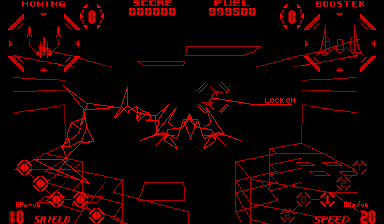
T&E Soft was not content to make a sprite-based diorama game, though. Of the three titles they released for the Virtual Boy (good for roughly 14% of its official library), all of them prominently feature polygonal graphics. Only Red Alarm goes all in, though. It is a “virtual reality” game in a beautiful Johnny Mnemonic type of way. Futuristic in a Tempest sort of way. It’s fully 3D, but we’re not shading any of those polygons, baby. Oh, no, we are in wireframe city. T&E Soft sacrificed opacity to deliver certainly the most 3D game to grace the Virtual Boy: the player, the enemies, and the world all rendered in 3D. Yes, some bullets and the HUD are rendered with sprites, but even the latter is set nicely in front of the action with the stereoscopic effect, making it appear like a diegetic dashboard.
Down to the wire
I really think it’s beautiful. As far as I’m concerned, if you throw on the optional first-person camera, that’s basically as close to virtual reality that the questionably named Virtual Boy could’ve managed. The thematic cherry on top is that the plot of the game is that you’re a flying ace tasked with piloting a Tech-Wing on a mission to destroy the evil sentient AI named “KAOS” before it wipes out humanity. Awesome. Perfect.
Pilot it you do, through 6 stages, blowing away ship after enemy ship. Like many 3D shoot ’em ups of its ilk, by passing your reticle over an enemy, you can lock onto them and fire a homing missile. Other than that, all the Tech-Wing has in its arsenal is its standard rapid-fire blaster. Both weapons are controlled with the same button. A press launches a missile at any locked-on targets while also shooting the standard weapon. This means you’ll spend most of the game pressing it madly. That’s part of the fun, right? Missiles connect with a satisfying explosion sound as enemies go to bits. When they drop power ups, a special sound effect is played so it’s not lost in the madness. And it is madness indeed, as the enemies keep coming at a steady clip.
Despite this, the game soldiers along at a pretty solid frame rate, especially by the standards of the time. This is aided by its wireframe aesthetic, of course, but also other graphical compromises. The draw distance is quite short, and all of the levels are essentially tunnels. Although it can at times look goofy, the game wisely draws enemies earlier the environment surrounding them. Additionally, unlike most shoot ’em ups, contact with the ground or walls does not inflict damage. I found the 3D space surprisingly parsable most of the time (even communicating themes and environmental character surprisingly well), but I won’t deny it took a bit of getting used to, so the collision lenience helped. All of these little decisions are smart and show a nice intentionality of design. They worked with the hardware they had.
I appreciated that thoughtfulness in preventing frustration, but I also seldom needed it in my playthrough. The ship is quite maneuverable. It has two well-tuned steering speeds (the faster of which is activated by holding L) as well as the ability to do a quick dodge up, down, left, or right. Additionally, it has two thrust speeds as well as a stationary hover and reverse. What’s more, the ship’s shields can take 10 hits, making it a bit tougher than the craft found in other similar titles. Although the levels are mostly linear, the ship can move in all directions as well. This is useful for discovering the occasional secret or doubling back for a missed missile or boost power up or shield refill.
It’s especially useful for the bosses, which greet you at the end of each stage. These fights move the action from corridors to an arena, wherein you fight KAOS’s toughest minions. Unfortunately, this is where the game’s draw distance woes hurt it the most. The area is so big, it’s quite easy to get disoriented. You are often too far from any walls to have much of a frame of reference, and there’s no radar or minimap to help you. Also, if the boss is simply far enough away, it just won’t render! Mercifully, it also won’t attack you in this state, but it can lead to a lot of wandering around simply trying to find the motherfucker. Not exactly thrilling stuff.
Once you manage to engage, the bosses are pretty all right, though. Each is appropriately themed to its environment (giant enemy crabs for the water level, a totem pole guy for the temple level, etc.), and fighting the later ones especially does take some thought. I was pretty irritated by the last couple bosses until I realized I had to approach them quite a bit differently from the early ones. My word of advice would be to remember that all of the ship’s movement options are there to help you — including the option to not move at all.
When you blow away KAOS (who looked pretty much exactly like what I’d want the evil AI to look like) and exit out the back of his base, the staff roll starts with startling immediacy. Names appear and disappear while, in a sequence as cliché as it is beloved, your ship makes its way out of a tight exit shaft as everything explodes around it. The triumphant credits music starts playing. You’re a hero.
I loved my 2.5 hours learning and beating this game (if you allow yourself save states even just at the start of levels, it would take you considerably less time, but it has finite continues, so I had to start over a couple times). Critical consensus isn’t exactly glowing around this one, but it isn’t really with respect to nearly any Virtual Boy title not starring Wario. I think sometimes something can be a bit shit and also be really great. But you have to be able to see the latter bit underneath the former. Maybe that’s just the cope of a contrarian, though.
Now you’re playing with Virtual Power
Anyway, I’m glad this is on Switch now. I actually added it to my Virtual Boy collection last year, having picked it up from Japan where boxed copies of Virtual Boy games can be purchased on the cheap. I returned home to discover both of my Virtual Boys are in pretty rough shape, suffering from an internal ribbon detachment issue that all Virtual Boys are doomed to incur at some point or another because of the type of glue that was used in them. I’m determined to get them fixed eventually, but it will be pricey. In the meantime, Nintendo’s silly $25 cardboard sleeve allowed me to play it in a way that does a pretty damn good job of approximating the real experience. Holding that contraption up to my face like a pair of idiot binoculars really felt appropriate.
My only gripe, really, is that the Joy-Cons do not wonderfully approximate the strange Virtual Boy controller, which was a dual-d-pad device (the only I can think of off the top of my head). The stick of the right Joy-Con is used instead, and it’s simply not a very precise way to approximate that, especially in a fast-paced action game like this. Oh, also, I think it’s basically completely insane and unconscionable that Nintendo doesn’t include digital manuals or at least original manual scans with these emulator apps. It sucks!! This is basic shit! Whatever. I keep fuckin’ downloading them anyway and buying their stupid cardboard toys.
If you also fire up the Switch Virtual Boy app, I hope you’ll give this one a shot. At least boot up Red Alarm and see if its opening cutscene sells you on what it’s all about. The sequence’s musical accompaniment is just another of the Virtual Boy’s many contradictions — tinny chiptunes on the device of the future. Effective, though. If you don’t think the game is good, I think you’ll at least find it has integrity. It tried to get as much Virtual out of the Boy as it could.