GAME CLEAR No. 280 -- Sonic Dream Team
video games game clear macos apple arcade sega hardlight sonicSonic Dream Team (2023, macOS/iOS)
Developer: Hardlight
Publisher: SEGA
Clear Version: macOS
Clear Platform: Mac mini (M4)
Clear Date: 2/27/26
| Why should I care? |
|---|
| They made a pretty good 3D Sonic game, man! Pretty good! |
I’m still in a dream
Wow! Who would have thought one of the great Sonic games of the 21st century would be an Apple Arcade exclusive? Not I! I didn’t know this shit existed until very recently, when I was looking at the Wikipedia list of every Sonic game after finishing Sonic and the Black Knight. I was just looking for a refresher; I was not expecting to be informed of the existence of a game released just over two years ago that I had never heard of and that was warmly received! After the rather unpleasant Black Knight, I was amenable to a palate cleanser in the form of a fun Sonic game. Dream Team served that purpose admirably by accomplishing what so few 3D entries in the beleaguered series have: it marries sensible art direction with controls that feel great both at speed and in lower-velocity precision moments. It’s a 3D blast.
My swiftness in downloading this game was aided by the fact that I am the new owner of a Mac mini. I was looking for a replacement for my very old personal desktop, and I landed on Apple’s compact option. So far I’ve been really pleased with the purchase. For the purposes of blogging, low-intensity hobby development, and general browsing and computing tasks, it’s been great. At a time when computer hardware is getting dramatically more expensive, it felt like a bargain even at Apple prices, and it’s nice to have something that will hopefully help weather that storm until this AI/data center madness subsides a bit. I’m also pretty uninterested in Windows 11, but I knew moving away from Windows would make my already very small PC gaming diet basically non-existent. Well, move over, Microsoft, the humble Macintosh has the game everyone wants: Sonic Dream Team. Since my Mac came with three free months of Apple Arcade, I was able to set aside my squeamishness with financially incentivizing subscription-only games and give it a go.
It runs beautifully on max settings on the diminutive device, which should perhaps not be too surprising since it also runs on iPhones (albeit presumably at somewhat reduced fidelity). So that’s nice.
Anyway, that’s a long enough digression about how my hardware purchases relate to my decision to play this game.
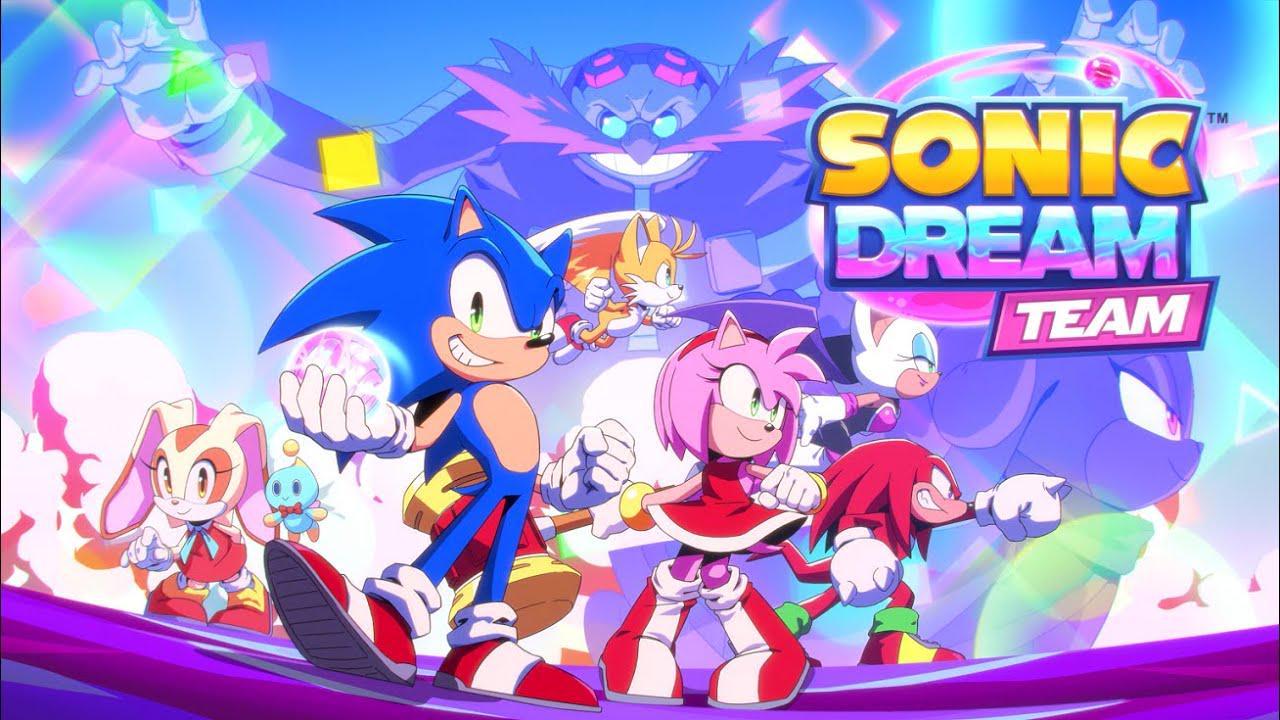
Sonic Dream Team is so called because it takes place in the subconscious of Dr. Ivo “Eggman” Robotnik and allows you to control multiple playable characters. When the long-time antagonist finds a device (the “Reverie”) that would allow his dreams to become a reality, he kidnaps Cream the Rabbit to use as a conduit, knowing the device only grants the wishes of those of pure heart. The guardian of this device, the charmingly named Ariem, is wise to his scheme and subdues him with the device, trapping him inside Reverie Haven, a world of dreams that now reflects Robotnik’s subconscious. When Sonic and the gang (Tails, Knuckles, Rouge, and Amy) arrive to rescue Cream, they’re knocked out by the device and brought into the dream world as well. Sonic is the first to encounter Ariem, who pleads with him to help solve the predicament of Robotnik’s presence and untoward ambition. Sonic agrees enthusiastically, and the story begins.
Typical of the genre, it turns out that Sonic needs to acquire a bunch of special objects in order to proceed — in this case, Dream Orbs. These strengthen Ariem so that she can pursue Eggman deeper into Reverie Haven and also so she can free Sonic’s friends, who are lost throughout, and assemble the titular Dream Team. Like more traditional Sonic titles, this one is broken up into a series of worlds which are themselves broken up into Acts. Each act has a base stage with an orb at the end, along with a number of other collectibles. After clearing the base stage, a number of different challenges open up as well, each of which awards an orb of its own. Some require specific skills. Knuckles and Rouge can glide through the air and climb walls, Tails and Cream can fly, and Sonic and Amy can do the light-speed dash from Sonic Adventure along a chain of rings. All are necessary at different times.
The stages are generally laid out fairly linearly, almost like a roller coaster or ski slope to be navigated using the skills of Sonic and his friends. Unlike some Sonic games of years past, that is true not just in intent but in execution. The universal moves of all characters include boosting, jumping, and homing attacks, which can be used on enemies and grind rails alike. It doesn’t take all that much deftness to fly through the stages gracefully, but bouncing off enemies and running up walls and hopping between grind rails at speed really feels cool. When you spot an alternate path and are rewarded with a collectible, it makes you feel clever too. Schmoving your way through a level without a hitch is both tricky and achievable. It feels great when you get into the necessary flow.
Rolling around at the speed of sound isn’t the only fun part. When the action slows down, it feels just as good, which is not something I’d say the series has always managed. When platforming requires precision or you’re hunting for a hidden collectible, Hardlight tuned the characters’ base run speed to be perfect for such occasions. With a tap of the boost button, you’re back at top speed ready to hurtle through the rest of the stage.
The only downside to how fun it is to navigate the stages is that there aren’t really any enemies to deal with in the traditional sense. Yes, there are the classic Eggman robots (powered by animals) to bash, but they never pose any sort of threat. They always exist to serve as objects to bounce off of with a homing attack in service of the acrobatics of progressing through a stage. This isn’t necessarily bad, it’s just different. On the plus side, the handful of bosses in the game are pretty solid and interface smartly with the cast’s limited combat moveset. The best of them are essentially stages themselves that you must navigate deftly in order to get to a position to strike the weak spot. But the arena-style fights are solid as well.
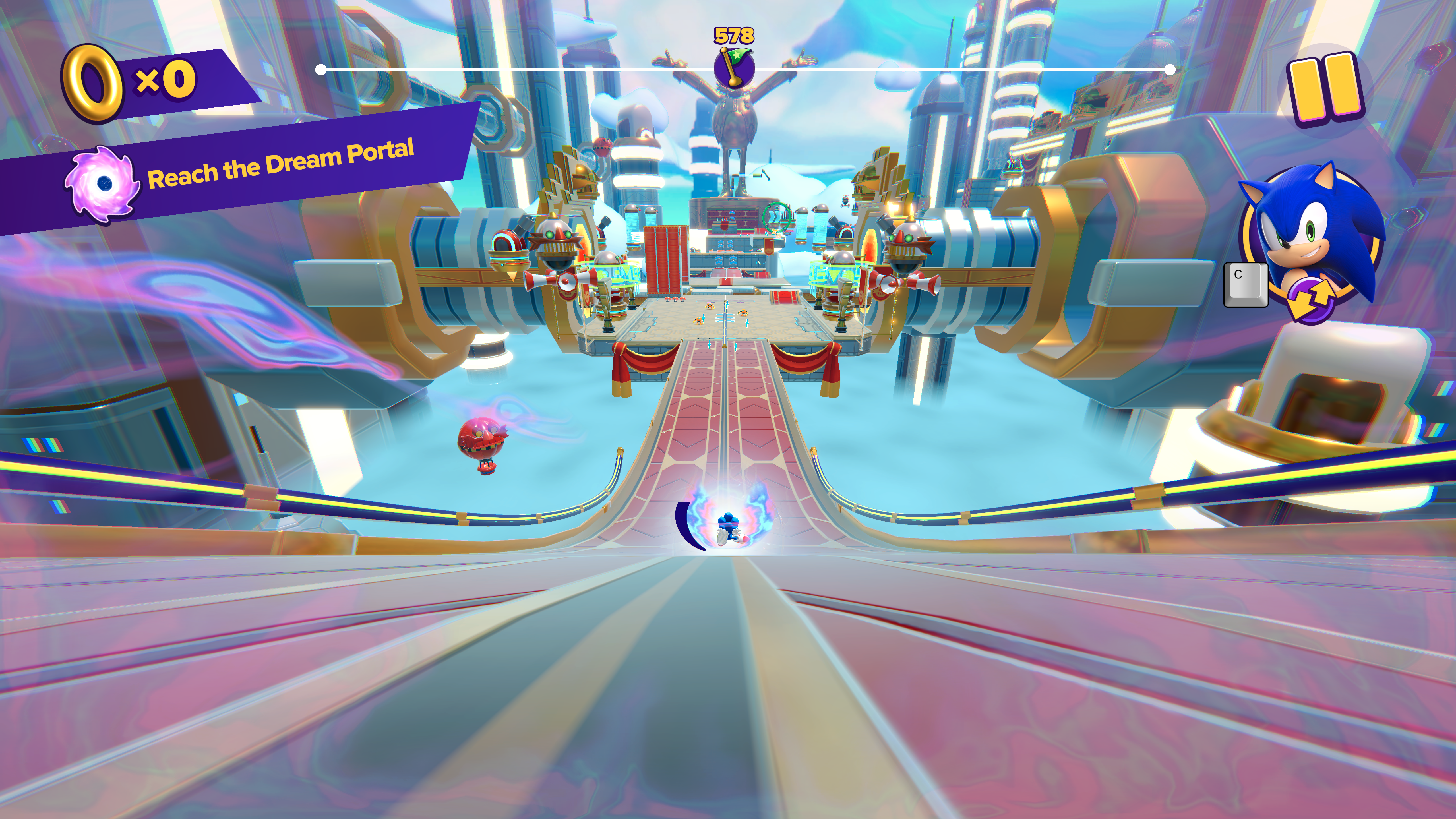
If I have any gripe with the flow of play, which is typically excellent, it’s that the collectibles in the base stages do demand some retread. The nature of locking them behind paths accessible only to certain characters necessitates this. Even though you unlock the ability to swap between them on the fly later in the game, the stages are not generally designed for backtracking. You’ll have to either warp back to a previous checkpoint to take an alternate path or play the stage again from the start. I just don’t love that.
The game also expects to you replay its levels regardless of whether or not you care about collectibles. Each stage requires a certain number of Dream Orbs to unlock, and you’ll never have enough by beating the base Acts on their own. The additional challenges in each Act at least tend to have some bespoke challenge to them, though. They tend to require you to navigate a new set of obstacles placed within a course or to navigate chunks of the level in a speedrun style. In some ways, the challenges feel like padding for length, but I never really tired of them.
Besides, replaying levels was part of the original Sonic design philosophy. From the very beginning, stages had multiple paths that rewarded repeat play. I think Hardlight honors that concept pretty well here. How well that sits with players will come down to personal preference.
I understand why the development team chose to do so as well, since Dream Team is pretty obviously a budget project. It’s only 12 levels long (including four bosses), so it could’ve been quite brief without some repetition. Cutscenes have voice acting, but they’re told through still images in a sort of comic-book style (except for the opening title sequence). It seems unlikely they had a blank check to make a massive game.
With what they did have, though, they respected what Sonic is about. The game has excellent art direction. It’s colorful, saturated, and looks like a Sonic game in a way games like Sonic the Hedgehog (2006) or Sonic Frontiers or indeed Sonic and the Black Knight do not. Hardlight also enlisted the work of great musicians like Tee Lopes and Johnny Atma for the soundtrack. It’s got a cheerful and memorable main theme. The stages themselves don’t have pieces as iconic as “Green Hill Zone” and “Chemical Plant Zone”, but they serve the action well and sound appropriate for the game. Some of these remarks may seem like basic stuff, but it’s remarkable how many times Sonic Team has missed the mark on one or more of these things!
Despite the somewhat limited scope of the base game, it has also been supported by some major content updates since its 2023 release. Tails Challenges were added, which are daily trials that take place both in the stages of the main game and in new stages designed just for the supplemental mode. Shadow the Hedgehog was also added as a playable character for the base game and Tails Challenges with all-new stages of his own. I don’t typically find a lot of value in “infinite” content streams like this for my single-player games, but it makes more sense when I recall that there’s also a substantial iPhone userbase for this game. Having an option to play a quick Tails Challenge or two on the train sounds pretty appealing.
Beyond that, if I had not known it was also on iOS, I would not have had any hunch that this game was developed to support both gamepad and touch controls. It feels great on a controller and almost too sophisticated for a phone screen, but I may well be wrong! I don’t have an iOS device to test it on, but if Hardlight managed to thread that needle, that makes this effort all the more impressive.
I’m so glad this game got made and that I finally became aware of it at a time when I had the hardware to play it. I really don’t love that it’s an Apple Arcade exclusive. I’d have gladly paid $20 to own this game forever. More importantly, we’ve already seen in Rayman Mini an example of a game in a major platforming series completely disappear from Apple Arcade unceremoniously and without any announced plans to port it to another platform. That sucks! If for whatever reason, legal or otherwise, this game can never make it to Windows or console, I hope Hardlight will at least be given the keys to do something else with the franchise. They’ve got a really solid foundation with Dream Team, and I’d love to see how they’d iterate on it.