GAME CLEAR No. 281 -- bit Generations: Dotstream
video games game clear skip ltd nintendo gba bit generations art stylebit Generations: Dotstream (2006, GBA)
Developer: Skip, Ltd.
Publisher: Nintendo
Clear Version: GBA
Clear Platform: Game Boy Micro
Clear Date: 3/2/26
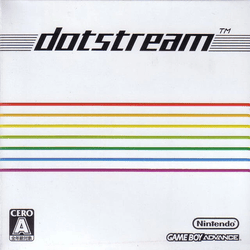
| Why should I care? |
|---|
| Dotstream is the most minimalist possible racing game. Its purity of essence is a sight to behold. |
Linear progression
Conceptually, I’m a pretty big fan of the bit Generations series. They’re a selection of budget titles released (only in Japan) for Game Boy Advance nearly two years after the launch of the DS. They employ simple but enjoyable gameplay mechanics and striking art styles (and were indeed released under the Art Style label outside of Japan as DSiWare and WiiWare titles). Since the DS is backwards compatible and these titles are suitable for short play sessions, they were sensible pickups for consumers looking for a secondary game to play when they weren’t in the mood for whatever was in the DS card slot.
They’re also pretty good! I’ve praised Pictobits on this very blog, and I’ve played and enjoyed a few others. I never played Dotstream, though, nor its WiiWare equivalent Light Trax. Now that I have, it has become my favorite of the series.
Dotstream is racing rendered down to its simplest form. You control a line (or, perhaps more accurately, a dot that leaves a line behind it) and race five others of different colors of the rainbow. Your view of the track is from above, and it runs from left to right. You can steer, brake, and use your limited boosts and occasional item pickups. Rather unconventionally, you have no gas/accelerate button. By default, you slowly accelerate to a steady speed after the race begins. You can increase this speed by driving your dot as close to the lines left behind by your opponents as possible.
The tracks are similarly minimally rendered. Obstacles, hazards, twists, and turns are represented by simple line art. Boost pads and slow-down sludge are rendered in a bit more detail, presumably for clarity, but most things are simple shapes. It is most critical to avoid solid shapes. These are effectively walls, and hitting them constitutes a crash. Doing so slows you down and takes a boost away. If you crash with zero boosts remaining, you lose the race instantly.
That’s what makes the dance exciting. In order to maintain competitive standing in a race, you must hang tight to your opponents’ lines and ration your boosts for good opportunities to overtake them. However, you can never occupy the same space as an opponent’s line. If you cross into it, the game auto-steers you into empty space. In particularly cluttered areas, this can lead directly to a crash. You have to exercise prudence without being overly cautious. In some scenarios, this may mean simply taking tighter turns through the course rather than trying to hang onto a slipstream. In the tougher races, you’ll have to master both.
The game is organized into six grands prix of increasing difficulties. They consist of five races each and are won by accumulating the most GP points. Pretty normal stuff. Racing on a course in GP mode unlocks it in the Spot Race mode, which allows you to drill single tracks. Although you obviously do not need to win every race in GP mode to win an individual GP, you will need to win a race on every single track in either Spot Race or GP mode in order to unlock the “ending” (ie, the credits cutscene). Exacting standards!
These bit Generations/Art Style games live and die on the vibes, and Dotstream’s are incredible. The colorful lines of the courses, racers, and menus are utterly striking against the pitch-black backgrounds of the game. Having played on original hardware, I don’t have any screenshots, but this lovely blog post has several representative ones. In addition to its visual beauty, its drum & bass and electronic soundtrack aligns well with its white-knuckle gameplay. It’s also reactive to it — driving into an obstacle or hazard may change the tempo of the music or add a drum fill suited to the effect on your “vehicle.” Tapping the d-pad around the menus also elicits various drum noises. You make music as you play.
The world of Dotstream is a beautiful one to be in. If you wish to stay there forever, you can play the endless Formation mode. It plays more like snake. As you glide your dot around consuming balls of light, you accumulate more dots to control. This makes it easier to crash but also easier to collect more light. I did not master this mode, but it seems like it could have some depth.
And I wouldn’t blame you for wanting to stay longer with this little game and bask in its glow. It’s the exact sort of thing I feel the small screen of the handhelds of yore were made for.