GAME CLEAR No. 309 -- Zero Racers
video games game clear virtual boy nintendo switch f-zeroZero Racers (2026, Virtual Boy)
Developer: Nintendo
Publisher: Nintendo
Clear Version: Virtual Boy
Clear Platform: Switch 2 (Nintendo Classics emulation)
Clear Date: 8/4/26
| Why should I care? |
|---|
| Nintendo has deigned to drop an unreleased ROM on us of Zero Racers, the Virtual Boy F-Zero. Despite problems, that’s worth celebrating. |
My time has not yet passed.
It’s not every day you get a new single-player F-Zero game. Indeed, there hasn’t been one in 22 years. There still hasn’t, really, but Nintendo has finally graced us with the finished-but-unreleased Zero Racers, which never really calls itself F-Zero but certainly is. I style myself as a big F-Zero fan, so I was quite anxious to play this as soon as it dropped. I’ve even allowed myself to indulge in the delusion that someone out there among my friends and acquaintances might specifically be interested in the thoughts of someone who so loves the franchise. That in mind, I made quick work of tackling the game’s Grands Prix (called “Ducts” in this game) on Expert difficulty to earn my credits roll and bring this post to you. There are frustrating elements about both the game and the handling of its release by Nintendo, but to get the doomed F-Zero 2 after all these years is still impossible not to smile about.
Likely owing to its release on the Virtual Boy’s bizarre and limited hardware, Zero Racers is a bit of an alternate-universe F-Zero. It still takes place in the distant future (the 2990s, to be precise), but instead of the intergalactic, space-future setting of every other F-Zero game, this one takes place underground on Earth. In this world, humanity has been forced into subterranean living (by what is unclear — presumably its excesses) and has even lost access to certain emotions (?). This, according to the brief bit of flavor text that accompanies the game in the Nintendo Switch Virtual Boy app.
What this means is that the races are held in tunnels instead of twisting racetracks suspended high above the metropolises of the F-Zero world. The ease of rendering tunnels with the Virtual Boy’s wireframe graphics was taken advantage of quite readily by Red Alarm, so why not here?
So there are some lore and setting differences, but the greater leap from the SNES F-Zero comes in the form of the game’s 3D graphics and omnidirectional control. The latter, in fact, separates this game from every other game in the series. Rather than piloting a craft that hovers inches above the racing surface, Zero Racers asks you to fly something more in the tradition of the Arwings of Star Fox (or X-Wings of Star Wars, if you prefer).
In nearly every other way, the game plays more or less like every other F-Zero, especially the original. Like its SNES predecessor, Zero Racers features rationed boosts (except you pick them up on the course instead of automatically earning them each lap) rather than having the health bar serve doubly as a boost meter. Clearing a Grand Prix/Duct also only requires that you finish 3rd or better on each constituent 5-lap race. Its four machines offer meaningfully different cross sections of top-speed/acceleration ratios and maneuverability. Familiar stuff. It’s a modest iteration in most ways, but, as a series veteran, I cannot overstate the extent to which piloting an aircraft is dramatically different from piloting a hovercraft. Such a significant gameplay change makes this game a bit of a Zelda II, and regardless of your feelings on that game, it makes it all the cooler that we finally got it.
Aside from being novel, it also kind of works! The fully enclosed nature of the race courses means that pilots are confined in much the same way as they would be by a track. Replace boost pads with boost rings, and you’ve pretty much got the same concept. Dealing with a whole other plane of movement is also served pretty well by the Virtual Boy’s odd dual-d-pad setup. One d-pad controls the pitch, yaw, and roll of the craft, while the other “slides” the craft through the air without affecting its orientation relative to its center of gravity.
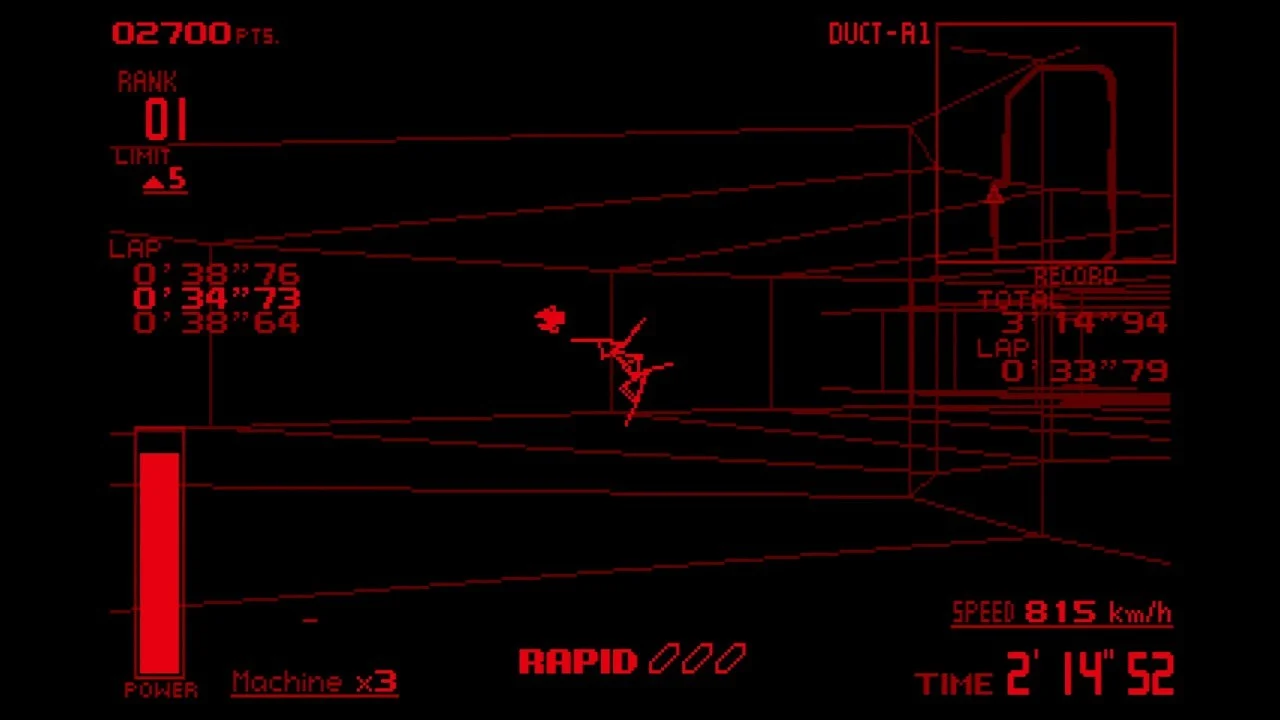
I’m not gonna lie to you, though, it feels like straight-up mud until you get used to it. I suppose there was probably a time in my life when traditional F-Zero felt similarly unwieldy to me, but holy moly. For the first hour or two of this game I was constantly fuckin’ slamming into shit. Of all things, the N64 controller Nintendo sells for the Switch works quite well as a substitute Virtual Boy controller. Its d-pad and C buttons are oriented basically exactly where the Virtual Boy’s d-pads were, and its shoulder and A/B buttons are also more or less in analogous positions. Probably a coincidence. While I think this helped, time was the biggest factor. That, and switching from my beloved Falcon machine to the newcomer Origammy (which, incidentally, looks exactly like a paper airplane). The latter’s got the best slide control in the game, which is killer for grabbing consecutive boost rings, and its best-in-game acceleration more than makes up for its worst-in-game top speed as it relates to keeping a noob in the pack. It’s not going to be setting any world records on the time trials, but if you just want to beat the CPU races, I can’t recommend it enough.
After I got in the groove, I went from thinking this was the worst game in the series to… probably still thinking that but at least also thinking it’s well worth trying. The game succeeds at creating tight, fun races that are as fun to win as they are in any other game in the series. That’s worth a lot; indeed, it’s why I’m glad I’ve played it. Unfortunately, the white-knuckle wins often come after a lot of wrestling with jank. Even as I’ve gotten better at the game, I still often don’t feel in terrific control of my machine, and collisions with walls and other racers just feel awful in a way they don’t in any other game in the franchise. Climbing and diving through dips in courses is particularly tricky and can often leave you grinding along a ceiling or floor taking constant chip damage and slowing way down, a fate even worse than a single violent bounce. Mastering tracks to avoid these troubles provides more of a feeling of relief from irritation than of true satisfaction.
Part of the culprit here is certainly the Virtual Boy itself. It simply isn’t cut out for this. Even the game’s extremely simple graphical representations of its courses are rendered sluggishly by the red and black machine. More sophisticated and pleasant collisions physics were likely too much to ask. It’s also quite literally true that its low frame rate makes it more difficult to react to things, and it also negatively impacts the sense of speed. Not ideal for an ostensibly high-speed racer! The contrast with F-Zero X, which managed the monumental task of running at 60fps on the fucking Nintendo 64, could not be greater. But that was a real 3D console. The Virtual Boy was much maligned for offering neither real, meaningful 3D nor real, meaningful virtual reality. That’s mostly true, but I argued in my Red Alarm post that the first-person view it offered at least kind of checked the VR box. Alas, Zero Racers doesn’t even have that.
Perhaps the Virtual Boy’s biggest offense imposed upon this game is that it plays no music during races, only an admittedly catchy post-race tune graces the events. Fucking unthinkable for a series with some of the best tracks in the medium. This is seemingly a design decision. If music were playing it would be impossible to hear the constant beeping of the game’s turn warnings. That’s right, the game tells you when you need to turn with a little HUD indicator and an obnoxious beep. Every time. I can only infer that this was done as a concession because of the Virtual Boy’s rendering shortcomings. I could almost accept that if I actually thought it was necessary, but I really don’t think the indicator ever helped me. What an absolute shame.
Nevertheless.
I love the game. I cherish it. It is practically a miracle that we got it at all. It is unlikely to be the F-Zero game I run back the most, but I’ll probably think about it and talk about it more than, say, the anime tie-ins on GBA. I reflected a bit on Bluesky about what a special thing it was to be playing a game like this at a time like this. So often, I am playing very old games for the first time. I come to them with fresh eyes, but unless I take great care to avoid such knowledge, I’m aware of their reputations. Often I know handed-down tips and strategies. I know that Aerith dies. Things like that. Not here! In the wee hours of the night, I was digging up info and posting it in the F-Zero fan Discord for, to the best of my ability to tell, the first time. As I slept and went to work, people caught up to and passed my progress, but what an absolute thrill those few moments were.
Yeah, it’s a bit shit, but what a treat. Even in its most compromised form, F-Zero gives me an itch to get better that no other single-player series does. I know I’ll keep playing this. There’s Master difficulty to overcome, after all.
Nintendo Beef Rant
Rather than try to pepper this into the above discussion about a game I’m fond of, I decided to write a little coda. I’ve written before and probably will again about Nintendo’s frankly unacceptable treatment of its catalog titles. Although I am utterly jubilant at the fact that this missing piece of playable F-Zero history has been released, I am dismayed at how Nintendo did what can only be described as the bare minimum.
Nintendo’s “Nintendo Classics” subscription apps are, and always have been, a far cry from the offerings of the Wii Shop Channel and its Virtual Console brand. Not only does it offer a fraction of the games despite being a thing that exists in the future of the other thing, the games it does have offer less too.
My primary beef here is that older video games are far less self-documenting than modern games. For any number of technical reasons, classic games usually did not contain tutorials or plot exposition (when they had plots at all). Information on how to play and what the concept of the game even was tended to be left to an instruction manual included with the physical software purchase at retail. Sure, it’s often discussed how World 1-1 of Super Mario Bros. does an excellent job of forcing the player to learn the basics simply by playing, but not all games were like that.
That being the case, Wii Virtual Console titles all included a digital manual that explained the controls and concepts of the game. These were bespoke, useful things for someone playing a game for the first time. They also allowed for the instruction text to be updated for modern audiences where appropriate. Great!
That process is, of course, labor intensive. I can see why Nintendo might want to be rid of that. Good news, Nintendo, home internet connections and bandwidths are much better than they were in 2006, not to mention internal storage sizes. You can just include a whole big-ass, high-res PDF of the original manual now! Surely you’ve done that, right?
Of course they haven’t. It frustrates me so much, largely because I remember what it was like to be a kid into games older than himself. I was no stranger to doing my own research to understand old games better, but rereleases have largely been marketed the same all this time. They are put back out to be purchased by people nostalgic for them, not new to them. What do you mean you want me to tell you what this game is? Why are you playing these old pixelated things if they don’t remind you of your carefree youth?
I understand the argument that that sort of supplemental information is more readily available to kids (and adults) than ever before. Archive.org has manual scans of every NES game ever released.
That’s the problem. Zero Racers was never released.
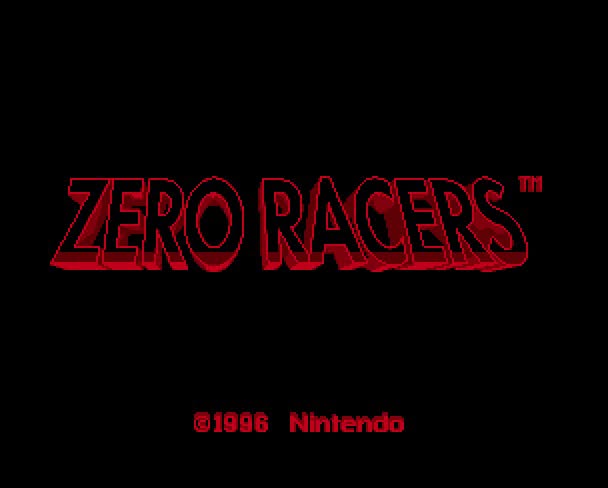
Nevertheless, according to former Nintendo employee Jim Wornell, it did have complete packaging, including a box art and manual. I have no reason to believe Nintendo has not archived those materials. So why is the game presented in the Nintendo Classics Virtual Boy app with just a title screen in place of its box art and a bit of flavor text accessible via button press? Why not give us the art? Why not give us the clearer look at the vision of this game that its manual would have surely supplied?
Meanwhile, why did Star Fox 2 get the royal treatment, with a whole cute interactive website serving as its manual? I guess in that case they were trying to move units of the Super NES Classic Edition, for which the game was exclusively released at the time.
Realistically, the simplest answer is probably that they just don’t care. F-Zero doesn’t do Star Fox numbers, certainly not on an app for a failed console that requires a dedicated peripheral to play on Switch, so why bother? If you’re asking me, I think you should bother out of respect for the people who made the game, whose lives were dedicated to it for a moment in time in the mid-1990s. You should also bother for me because I want it.
All of this is stuff I’ve complained about forever. I probably always will, especially as it relates to Nintendo. They ain’t doing it like Digital Eclipse. I doubt they ever will. Then again, I likely also would never have guessed that they’d even put this ROM out. Maybe one day they’ll surprise me.
Until then, I’m glad the ROM got dumped. Pirate it like hell and give it a go on your original Virtual Boy. It deserves to be enjoyed in its full glory, free from the rent-based digital confines in which Nintendo has begrudgingly offered it to us. I’ll join you there one day if I can ever get my poor sick Boy fixed.