GAME CLEAR No. 287 -- Smash Ping Pong
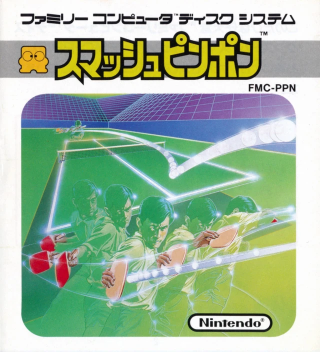
video games game clear konami nintendo family computer family computer disk systemSmash Ping Pong (1987, Family Computer Disk System)
Modified Port of: Konami’s Ping Pong (1985, Multiplatform)
Developer: Nintendo, Konami
Publisher: Nintendo
Clear Version: Family Computer Disk System
Clear Platform: Family Computer Disk System
Clear Date: 3/28/26
| Why should I care? |
|---|
| Smash Ping Pong is a cracking sports title, a terrific console port, and a fine direct descendant of video games’ common ancestor. |
Service ace
This game rocks. It’s just ping pong, but it feels a hell of a lot more like that game than most sports games of the ’80s. It’s a port of the 1985 arcade game Konami’s Ping Pong by Nintendo to their then-still-new Disk System. It’s a quite competent port and now features a healthy dose of the Disk System’s mascot Diskun. Aside from a dash of Nintendo branding, it’s just straight up table tennis. It’s a high-velocity simulation with terrific feel, and I love it.
I was first put onto this game by a post by Mathew Kumar, who is another guy who writes about every game he finishes. I thought it looked sick, and I was hungry for an excuse to keep playing my Famicom Disk System after having recently returned to it for some golfing fun. A quick visit to eBay later, my impulse purchase was made and on its way.
I was pleased to find its control as fluid and expressive as it appeared in clips. It’s fairly simple. You control a disembodied hand holding a paddle from a point of view behind it. When serving, the d-pad moves the hand to your desired starting location, and the B button tosses the ball up for service. After that, the d-pad is instead used for shot selection. Your hand tracks the ball automatically as your opponent returns it, so all you have to do is time your swing correctly. You can hit the ball back in such a way to increase or decrease its speed by pressing left or right respectively. If you hear an audio cue indicating your opponent has returned your shot particularly softly, you can press up to perform the titular smash swing, which is very fast and difficult to return. You can press A to switch to the backhand position, which is occasionally useful for returning certain shots.
That’s just about it. It’s not complicated, but the magic is in timing your swings. Early swings go to the “pull” side, if you will. That is, more to the side of the direction of the swing. Later swings are pushed. Pretty intuitive, but the granularity at play is significant and demands some pretty deft timing to place your shots just where you want them. Rallies can be quite extended as you toe the line between keeping the ball in play and placing it somewhere difficult for your opponent to return. Failing that, you can try to disrupt their timing with unpredictable return speeds.
All there is to do in this game is play against the computer or a friend, but the CPU serves as a very worthy adversary. Even on Level 1 difficulty (out of 5), it took me keeping my wits about me to win a best-of-three set in Games A and B (11 and 21 point games, respectively). I could feel myself getting better all the while, and I hope to get good enough to eventually tackle its hardest challenge.
In the meantime, I’d love even more to play against a human. I have the means. I’ll get somebody over here to play some Nintendo floppies with me.